Research Note
I Put a Jacobian Lens on Gemma 4 31B. The Signal Got Stronger—and Less Specific.
Does a Jacobian lens become more useful when the model gets much larger—or does scale mostly make the ordinary logit lens better?
My last Jacobian-lens experiment ended with that question and an obvious next step: try the same measurement on a larger open model with enough memory to stop treating every gigabyte as a crisis.
So I moved the experiment from an RTX 3080 Ti to an NVIDIA DGX Spark, scaled the same controlled protocol through Gemma 4 E4B, 12B, and finally 31B, and let the largest fit run for 36 hours.
The result was both stronger and less magical than I expected.
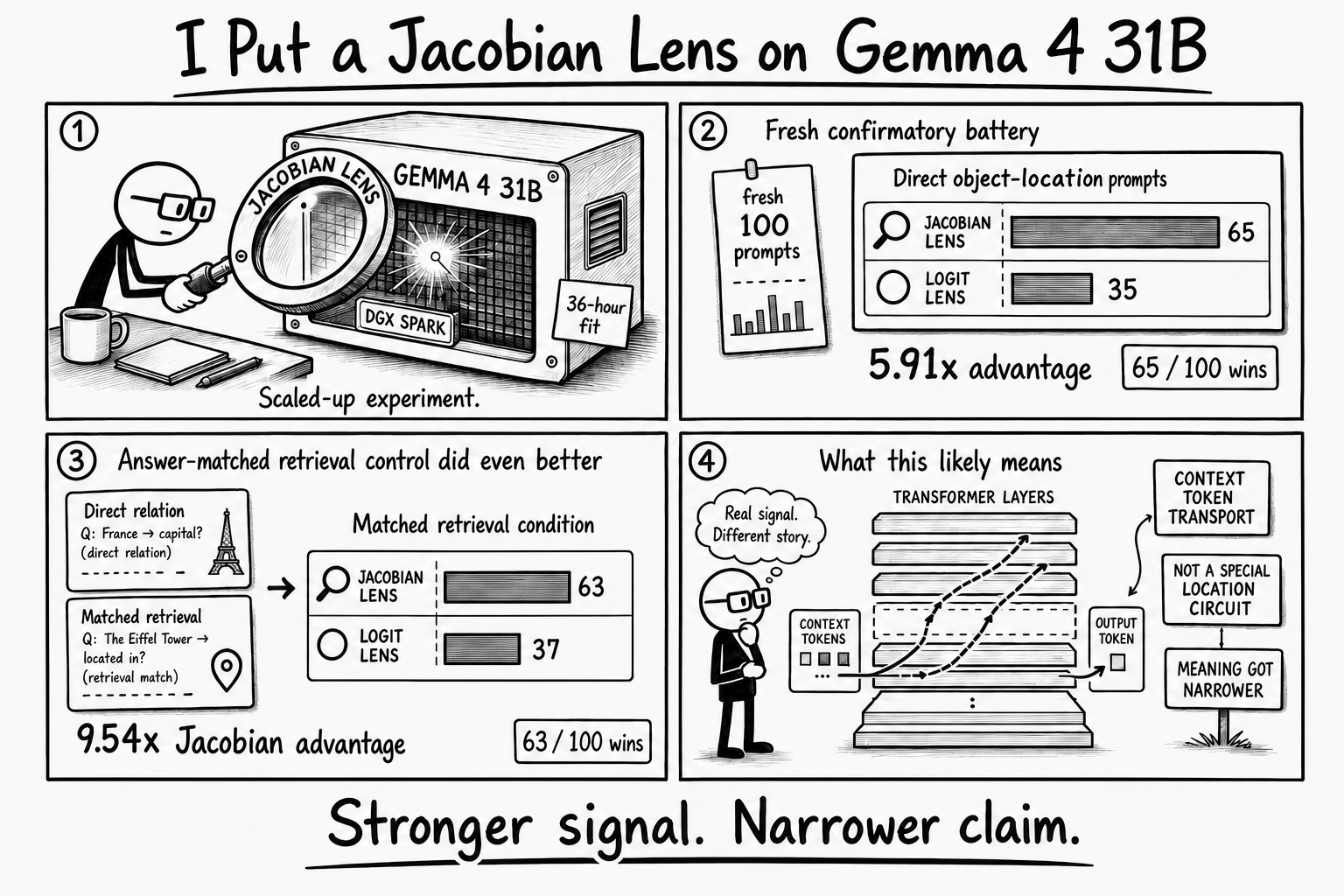
At one layer in Gemma 4 31B, a fixed Jacobian lens beat the ordinary logit lens on a fresh, preregistered set of 100 direct object-location questions. Its median answer-token rank was 5.91 times better, the bootstrap interval excluded parity, and it won 65 of 100 paired cases.
Then the most important control did even better.
When I replaced each location question with an answer-matched prompt that simply asked the model to retrieve a word already present in context, the Jacobian advantage increased to 9.54 times.
That does not erase the signal. It changes what the signal most likely means.
Code and results: The scripts, frozen battery, preregistration, raw ranks, and negative controls are pinned to release tag v0.2.0.
TL;DR (Layman Version)
I built a mathematical readout that asks how activity inside a large Gemma model will flow toward its eventual next-word scores. On 100 new questions, that readout exposed the expected answer more clearly than a simpler baseline. But it helped even more when the task was just to copy a word from the prompt.
So the lens appears to capture a real, reusable route for bringing context tokens toward the output. It does not show that I found a location-reasoning circuit, a transcript of hidden thought, or a universal workspace.
What I Was Scaling
A logit lens takes an intermediate activation and decodes it as if the model were already done processing. It is simple and useful, but it ignores every transformer layer that still comes next.
A Jacobian lens asks a more local question:
If this intermediate activation changed by an infinitesimal amount, how would the model’s final word scores change after the rest of the network processed it?
The Jacobian is the derivative of that downstream transformation. Averaging it over calibration text produces a linear transport map from one internal layer toward a later layer where language can be decoded.
In the first post, this method found a useful, prompt-sensitive readout in Gemma E2B and a small causal probability shift. It did not reveal a clean Jacobian-specific workspace band. The obvious possibilities were that the model was too small, the calibration set was too small, or the 12 GB GPU forced the experiment into an unhelpfully narrow part of the network.
The DGX Spark removed the hardware excuse. Its 128 GB coherent memory let me fit larger models, retain gradients through the frozen network, and checkpoint matrices that would have been impractical on the original machine.
This was still not fine-tuning. The Gemma weights never changed. I was fitting readout matrices, not training the model.
Setup
- Hardware: NVIDIA DGX Spark with 128 GB coherent memory.
- Models: instruction-tuned Gemma 4 E2B, E4B, 12B, and 31B at pinned Hugging Face revisions.
- Calibration: the same 100 short passages, with lenses saved at 10/20/35/50/75/100 prompts.
- Readout layers: five depth-matched source layers per model transported to its final stable target layer.
- Primary comparison: paired
log10(Jacobian answer rank / logit answer rank)on fixed, held-out one-word prompts. Lower is better. - Controls: identity transport, coordinate-shuffled Jacobians, and norm-matched random matrices where applicable.
Every long fit saved an atomic FP32 running sum after each prompt, then emitted compact FP16 lenses and raw JSON readouts at the declared milestones.
Bigger Models Did Not Produce a Simple Scale Curve
I first reran the same 100 calibration passages and 40 held-out one-word questions across E2B, E4B, 12B, and 31B. Each model used five layers at approximately matched depth fractions. At every milestone I compared the Jacobian lens with the identity-transport logit lens on exactly the same prompts.
Negative values below favor the Jacobian lens. The “best layer” is descriptive—the layer with the lowest paired median after the fact—not a universal layer selected in advance.
| Model | 100-prompt descriptive layer | Median log10(J-rank / logit-rank) | 95% bootstrap interval | J/logit/ties |
|---|---|---|---|---|
| E2B | 8 | -0.763 | [-1.172, -0.456] | 34/6/0 |
| E4B | 26 | -0.699 | [-1.404, -0.540] | 35/5/0 |
| 12B | 43 | 0.000 | [0.000, 0.151] | 1/14/25 |
| 31B | 38 | -0.293 | [-0.452, 0.299] | 23/17/0 |
The clean story would have been a smooth improvement with parameter count. That did not happen.
E2B and E4B showed strong descriptive advantages at particular layers. The 12B model became so readable near the end that the logit lens saturated at rank 1 and left little room for a learned transport to help. The 31B model showed a modest possible advantage at layer 38, but its interval still crossed parity.
Larger models often had stronger native late-layer representations. That can make the logit lens better faster than it makes the Jacobian lens distinctive. “The model is easier to decode” and “this particular lens is better” are not the same claim.
The Interesting 31B Signal Was Narrower
The aggregate 40-question result hid a category split at layer 47.
On ten object-and-location prompts, the 100-prompt 31B Jacobian lens reached a median answer rank of 345.5, compared with 2,044 for the logit lens. On factual recall and basic classification, the logit lens was substantially better. Arithmetic was close.
That made layer 47 interesting—but it was a discovery on a tiny subset. Treating those ten cases as confirmation would have been the easiest possible way to fool myself.
Instead, I froze a new battery before evaluating it.
A Fresh, Answer-Matched Confirmatory Battery
The new battery contained 300 prompts arranged as 100 triplets. Every triplet used the same answer word in three conditions:
- Direct relation: “The badge is inside the bag. Where is the badge?”
- Multi-step relocation: “The badge started in the cart. It was then moved to the bag. Where is the badge now?”
- Matched token retrieval: “The clerk wrote the verification word bag. What verification word was written?”
The third condition is the important control. It preserves the expected answer token and requires contextual retrieval, but it removes the object-location relation I thought might be special.
I generated and hashed all 300 prompts, froze the layer-47 lens and model revision, and wrote down the primary success criteria before running the model. I also disclosed that the hypothesis and layer came from the earlier exploratory battery. This was post-discovery confirmation, not a pristine first hypothesis.
The primary test required all three of the following on the 100 direct-relation prompts:
- a median Jacobian/logit rank ratio of at most 0.5;
- a bootstrap 95% interval entirely below parity; and
- an exact paired sign-test p-value below 0.05.
All three passed.
| Frozen layer-47 subset | J/logit/ties | Median J/logit rank ratio | Jacobian advantage | 95% ratio interval | Sign p |
|---|---|---|---|---|---|
| Direct relation | 65/35/0 | 0.169 | 5.91x | [0.122, 0.574] | 0.00352 |
| Multi-step relocation | 65/35/0 | 0.131 | 7.65x | [0.080, 0.359] | 0.00352 |
| Matched token retrieval | 63/37/0 | 0.105 | 9.54x | [0.068, 0.348] | 0.0120 |
This is the strongest readout result in the project. It survived fresh prompts, a fixed layer, a fixed lens, a confidence interval, and a paired test.
It also undermined the most tempting interpretation.
Passing the Primary Test Was Not the End of the Test
If layer 47 carried a special object-location representation, the direct and relocation prompts should have enjoyed an advantage beyond the matched copying control.
They did not.
Within each answer-matched triplet, I compared the direct-relation log rank ratio with the control log rank ratio. The median direct-minus-control contrast was +0.248 log10 units, with a 95% bootstrap interval of [+0.108, +0.372]. Negative values would favor a relation-specific Jacobian advantage. The observed interval was entirely positive.
In plain language: the Jacobian lens helped most when the answer word was simply available to be retrieved from context.
The honest interpretation is therefore narrower:
Gemma 4 31B layer 47 contains a robust transport signal that makes a contextually relevant token easier to recover than an identity-transport logit lens does.
That may still be useful. Contextual retrieval and copying are central operations in language models. A lens that captures their downstream transport could become a live diagnostic: show which prompt tokens are being routed toward the answer as a conversation unfolds.
But it is not evidence for a dedicated location-reasoning mechanism. It is certainly not enough to establish the full global-workspace properties reported in the work that inspired this study.
The 36-Hour Fit—and the Reboot That Did Not Ruin It
The 31B fit made the difference between inference and interpretability compute very concrete.
Ordinary inference runs the network forward. This experiment repeatedly propagated derivative
information from five source layers—14, 27, 38, 47, and 55—to target layer 59. At
dim_batch=1, each calibration prompt took an average of 1,300.88 seconds. The 100-prompt fit
took 36.14 hours and peaked at 63.13 GB of PyTorch allocation.
The saved FP16 lens is about 289 MB. The resumable FP32 running sums are about 578 MB. Those are small compared with the model, but expensive to produce.
Halfway through, the experiment also became a systems test. While Gemma held roughly 63 GB in the Spark’s shared memory pool, another local service tried to load a 284B GGUF model with an enormous context. The NVIDIA driver ran out of memory, the machine became unresponsive, and I eventually had to reboot it.
The fit survived because it wrote an atomic checkpoint after every prompt. The prompt-6 checkpoint was finite and complete, so the service resumed from prompt 7 instead of starting over. Afterward I paused other model-serving services during the long fit.
The lesson is mundane and important: on a unified-memory machine, “another model fits by itself” does not mean it can safely coexist with a long gradient job. Freedom to run everything is useful; resource isolation and resumable checkpoints are what keep that freedom from destroying a day of work.
Was 100 Calibration Prompts Enough?
Enough for this result, yes. Enough forever, no.
At prompt 100, the latest layer-47 contribution changed the running mean matrix by about 1%. That is a useful convergence sign, and the confirmatory result was measured on 300 completely new prompts. Fitting another hundred calibration passages would have been much less informative than spending that compute on a larger held-out battery with an answer-matched control.
Convergence should decide this question, not a round number. More calibration may still improve the matrix, but it cannot rescue the relation-specific story from a control that already produced a stronger effect.
Reproducibility and Artifacts
The 31B run used google/gemma-4-31B-it at revision
842da3794eaa0b77d5f08bae87a17459d91ff475. The frozen battery SHA-256 is
7716882e2c23963bca04e6a55c9f61c873f40582d8b43eb1b1d5239bf7c1c73a; the final FP16 lens
SHA-256 is 6d4dc94b50cd899f7b7ec6c4c35e1a1af9a84ff029688159f8308e27817ec183.
Release v0.2.0 includes:
- the frozen preregistration;
- the 300-case battery;
- the complete confirmatory readout; and
- a compact human-readable result report.
The multi-hundred-megabyte lenses and resumable FP32 sums live in a separate model-artifact repository rather than Git. Every stored tensor was verified against its local content hash.
What This Experiment Established
It established that:
- a 100-prompt Jacobian lens can be fitted reproducibly on Gemma 4 31B with consumer-accessible workstation hardware;
- a post-discovery layer-47 signal replicated on 100 fresh direct-relation prompts;
- the fixed Jacobian lens produced a large paired answer-rank advantage over the logit lens in that condition; and
- the same transport was at least as useful for multi-step relocation and even more useful for explicit contextual token retrieval.
Limitations
It did not show:
- a monotonic relationship between model size and Jacobian-lens quality;
- a location-specific representation at layer 47;
- that the lens reads a format-independent hidden answer;
- that this transport is causally necessary for the model’s behavior;
- a universal J-space or model-wide global workspace; or
- anything about consciousness.
The primary preregistered test passed. The broader interpretation got narrower. Those statements can both be true.
Where I Would Take It Next
The lens artifacts are now worth using rather than merely archiving. My next step would be a live viewer attached to a normal inference server: as I talk to Gemma, capture selected residual states and display the layer-47 Jacobian projection beside the ordinary logit lens. That would test whether the contextual-retrieval interpretation appears in natural conversations rather than only in one-word synthetic prompts.
The stronger scientific follow-ups would be:
- Freeze a natural-text retrieval battery where the relevant token appears far from the answer boundary and competes with plausible distractors.
- Test paraphrases and answer formats to measure how stable the layer-47 advantage really is.
- Intervene along fixed, cross-prompt directions and measure whether retrieval succeeds or fails, rather than only reading token ranks.
- Compare the same lens with stronger tuned-lens and probe baselines, not only identity transport.
- Repeat the answer-matched battery on another 31B checkpoint to separate architecture from one model revision.
The public repository contains the scripts, exact prompt hashes, raw JSON/CSV readouts, and frozen analysis plan. The large tensor checkpoints are separately archived with content hashes so the lens can be reused without pretending Git is a model registry.
TL;DR
Scaling to Gemma 4 31B produced a real, preregistered Jacobian-lens signal. The control that made the claim smaller also made the result better: this looks less like a special reasoning workspace and more like a measurable transport route for contextually relevant tokens.