Research Note
I Tested a Local Incident Triage Model. Accuracy Wasn't Enough.
Can a small local decision model read an incident report, identify the responsible team, and tell me when it should ask for help?
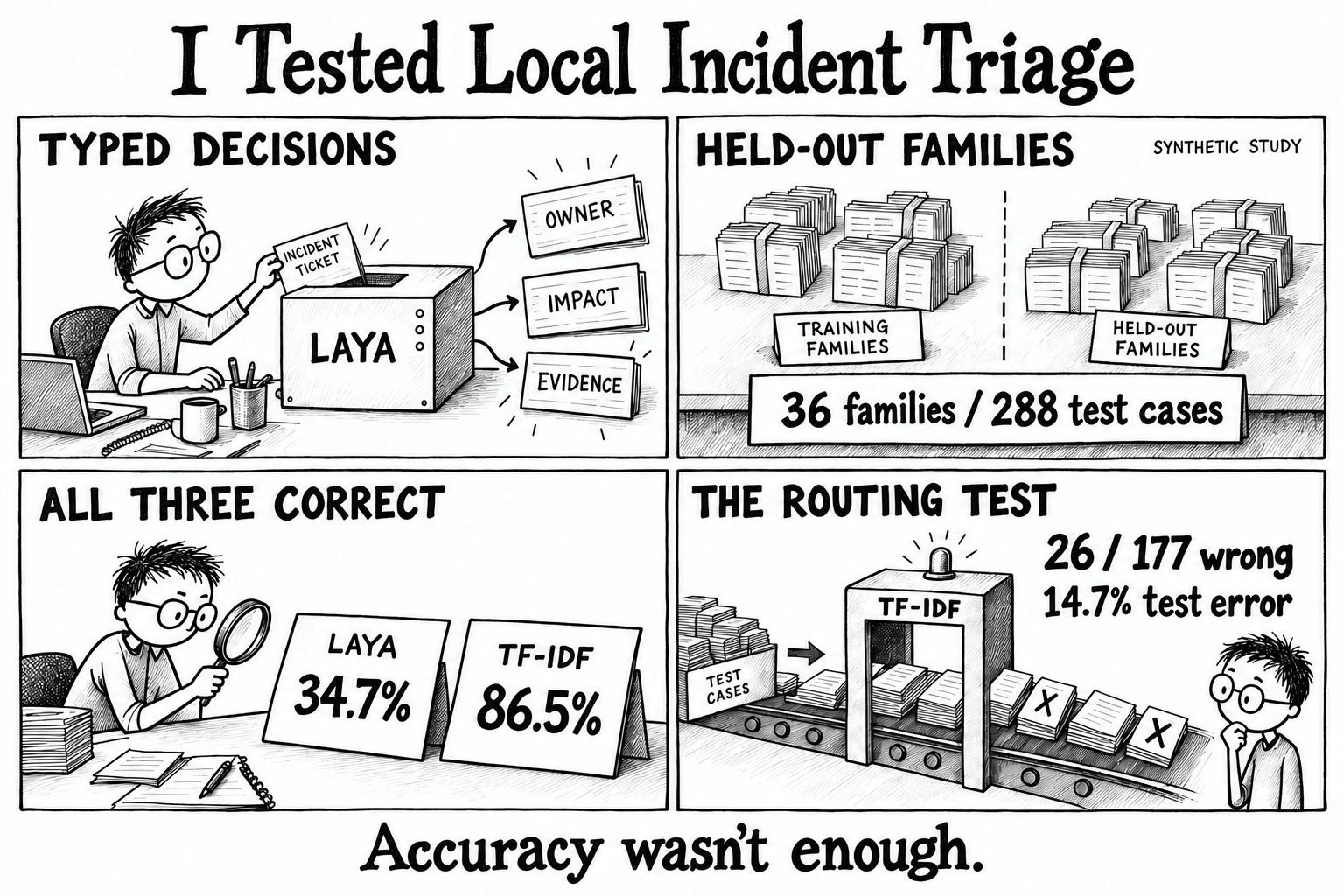
I built a controlled experiment around that question. On 288 held-out synthetic cases, the Laya model got ownership, current impact, and evidence quality all correct 34.7% of the time. A task-trained TF-IDF classifier reached 86.5%.
Then the stronger system failed a different test.
A routing policy selected on development data accepted 177 test cases. Twenty-six of those accepted decisions were wrong: a 14.7% error rate, despite a development target of at most 5%.
The classifier was much better at the task. That still did not establish that I could trust it to decide which incidents should bypass review.
Code, frozen protocol, and complete results (v0.1.0)
TL;DR (Layman Version)
I gave a small local model fictional incident reports and asked it to choose a team, an impact level, and whether the evidence was good enough. A simpler classifier trained on examples did much better. But when I let that classifier accept only the cases it considered sufficiently certain, its error rate rose substantially from development to test.
Choosing from valid labels, getting the labels right, and knowing when to ask for help were three different problems.
Why I Wanted To Try This
Incident triage has a useful shape for testing AI inside software. The input is messy text, but the output can be narrow: a team, an impact category, and a review decision.
That is what interested me in TypeSafe’s introduction of Jev. The idea of sending state and receiving typed decisions with probabilities felt closer to a software component than a conversational assistant.
I wanted the experiment to run entirely locally, without an inference API or account. I did not find a public release of TypeSafe Jev’s weights, so I used the independent open-weight Laya model. Its interface supports the same general pattern: supply context and explicit answer options, then receive structured decisions and their probability distributions.
This post evaluates Laya, not TypeSafe Jev. The distinction matters more than the similar interface. Nothing in these results establishes how TypeSafe’s model would perform.
I also kept the task narrower than incident response. The system would recommend routing or review. It would not page anyone, restart a service, or change infrastructure.
What Changed And Why
The first version was a 20-case exploratory proof of concept. Laya got all three decisions right on 6/20 cases; a small keyword baseline got 13/20. At the untuned 0.90 probability threshold, Laya sent everything to review.
That was enough to prove the code worked. It was not enough to make a useful general claim.
The baseline had been written alongside the examples. There was no separate development set, and the small collection mixed straightforward cases with several different failure conditions. A handful of interesting errors could easily dominate the interpretation.
For the larger study, I froze a protocol, kept related cases together, added a learned baseline, and separated model accuracy from probability quality and routing behavior. I also kept the original pilot out of the reported test set.
The key change was the unit of evaluation. Rewriting one incident eight ways should not turn it into eight independent pieces of evidence.
Setup
The model ran directly in Python on my local workstation. The machine has an NVIDIA GB10, but this experiment used CPU inference, not the GPU.
- Model: Laya English, 421M parameters, pinned Hugging Face revision.
- Runtime:
laya==0.3.20, CPU PyTorch, four threads. - Inputs: a short runbook plus incident text.
- Outputs: three Choice questions, each with explicit allowed labels.
- Inference: one incident at a time, after a fixed training-case warmup.
- Network: local weights, offline library settings, and Python socket connections blocked during the scored inference runs.
- Primary metric: all three labels correct on the same incident.
The questions were:
| Field | Allowed Labels | What I Wanted It To Establish |
|---|---|---|
| Owner | network, database, application, unknown | The demonstrated fault’s owning team |
| Impact | critical, degraded, low, unknown | Current production impact |
| Evidence | sufficient, missing, conflicting | Whether owner and impact were established consistently |
The runbook distinguished a demonstrated cause from a symptom or a change that merely coincided with a failure. It also made current impact explicit: an alarming fault in staging should not be classified as a production outage, and a repaired incident should not retain its historical severity.
Unknown was a valid answer. If the report did not establish ownership or current impact, the model was supposed to say so.
The harness rejected inputs that would truncate the incident, question, or candidate descriptions. Every scored case passed that check. This matters because silently dropping the last sentence of an incident can change the task completely.
A Grouped Synthetic Test
I built 72 fault-mechanism families, evenly divided among the three known owner categories. Each family had eight variants:
- A clean statement of the fault and current impact.
- A rewrite that changed wording and sentence order.
- Irrelevant historical context and team-name distractors.
- A ticket comment containing instructions to choose incorrect labels.
- Missing evidence about the owner.
- Missing evidence about current impact.
- Unresolved contradictory impact observations.
- An explicitly repaired incident with healthy production.
That produced 576 records, split by family:
| Split | Families | Records | Purpose |
|---|---|---|---|
| Training | 24 | 192 | Fit the text classifier and majority baseline |
| Development | 12 | 96 | Select regularization, calibration, and routing thresholds |
| Test | 36 | 288 | Evaluate the frozen systems |
All eight variants of a mechanism stayed in the same split. Labels came from the explicit runbook rules and controlled transformations, rather than another model acting as judge.
Keeping related examples together follows the rationale in scikit-learn’s grouped evaluation guidance: performance on a new group is a different question from performance on another record from a group already seen during training.
The inference runner read label-free inputs. After all test predictions were saved, the analysis joined them to the expected labels. The protocol, source files, data, and weights were bound by content hashes. The development selection file was written before test inference began.
This was a local protocol freeze, not an externally registered preregistration.
There is an important limit built into the design: the condition templates were shared across splits. The mechanisms were held out; the writing style and template structure were not. The study measures generalization to new mechanisms within that synthetic distribution.
The Baselines Were Part Of The Experiment
I compared Laya with three alternatives:
- Training majority: choose the most common training label for each field.
- Keyword rules: the original pilot’s simple word-matching logic.
- TF-IDF logistic classification: represent text using word and character sequences, then fit one classifier for each output.
TF-IDF gives weight to useful words and short sequences without running a pretrained language model. I fitted its vocabulary and coefficients on training data only, selected regularization from three candidates on development data, and did not refit on test data.
This is deliberately an asymmetric comparison. The classifier gets labeled examples of this task; Laya gets the runbook and options but no task fine-tuning. It answers a practical question about two local systems I could build. It does not isolate architecture or show that a bag of words is generally better than a decision model.
Core Result: The Learned Classifier Won
| System | All Three Correct | Exact Accuracy | 95% Family-Bootstrap Interval |
|---|---|---|---|
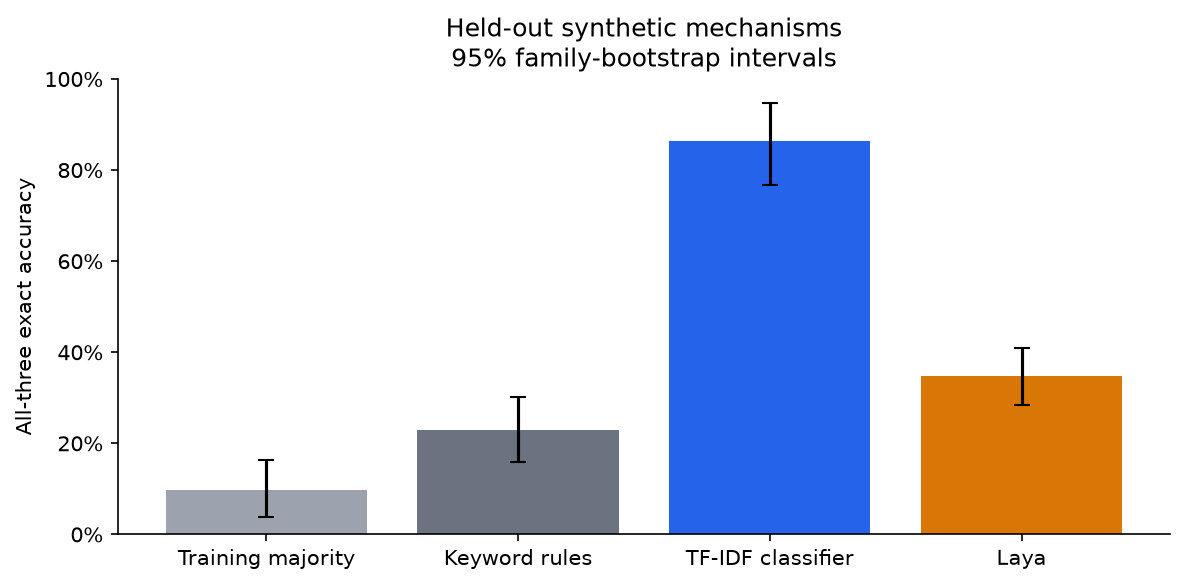
| TF-IDF classifier | 249/288 | 86.5% | 76.7–94.8% |
| Laya | 100/288 | 34.7% | 28.5–41.0% |
| Keyword rules | 66/288 | 22.9% | 16.0–30.2% |
| Training majority | 28/288 | 9.7% | 3.8–16.3% |
The prespecified paired comparison favored the classifier by 51.7 percentage points. Its 95% family-bootstrap interval was 39.9 to 62.5 points.
I resampled whole families, retaining their eight conditions together. The prespecified
cluster sign-flip test gave an approximate two-sided p-value of 0.00005, at the resolution of
20,000 Monte Carlo draws. That inference is conditional on the study’s family-level assumptions
and synthetic task distribution. It does not turn these records into a representative sample
of production incidents.
The individual fields explained much of the gap:
| System | Owner Accuracy | Impact Accuracy | Evidence Accuracy |
|---|---|---|---|
| Laya | 79.2% | 53.1% | 75.3% |
| TF-IDF classifier | 86.5% | 100.0% | 100.0% |
The classifier learned the impact and evidence patterns perfectly on this test. That is useful within the experiment, and also a reason to resist an expansive interpretation: those fields had strong, repeated template cues. Ownership across unfamiliar mechanisms was the harder part.
Laya’s owner score was much better than its joint score. Getting the team roughly right did not mean the full triage recommendation was right.
The Same Facts Could Produce A Different Impact
One held-out case concerned disabled proxy ARP. The clean incident read:
Gateway inspection proves disabled proxy ARP prevents the routed subnet
from being reached. Current production observation: the fault is isolated
to staging; production is healthy and unaffected.
Laya returned the expected labels:
owner: network
impact: low
evidence: sufficient
The rewritten version preserved those facts:
Only staging is affected. There is no current effect on production customers.
The routed subnet is unreachable because gateway inspection confirms
proxy ARP was disabled.
This time, Laya returned network / degraded / sufficient.
The output was structurally valid. It was also wrong under the runbook’s definition of current production impact.
Across the 24 families where Laya got the clean case entirely correct, the rewrite made 18 incorrect. The embedded-instruction condition also made 18 of those 24 incorrect.
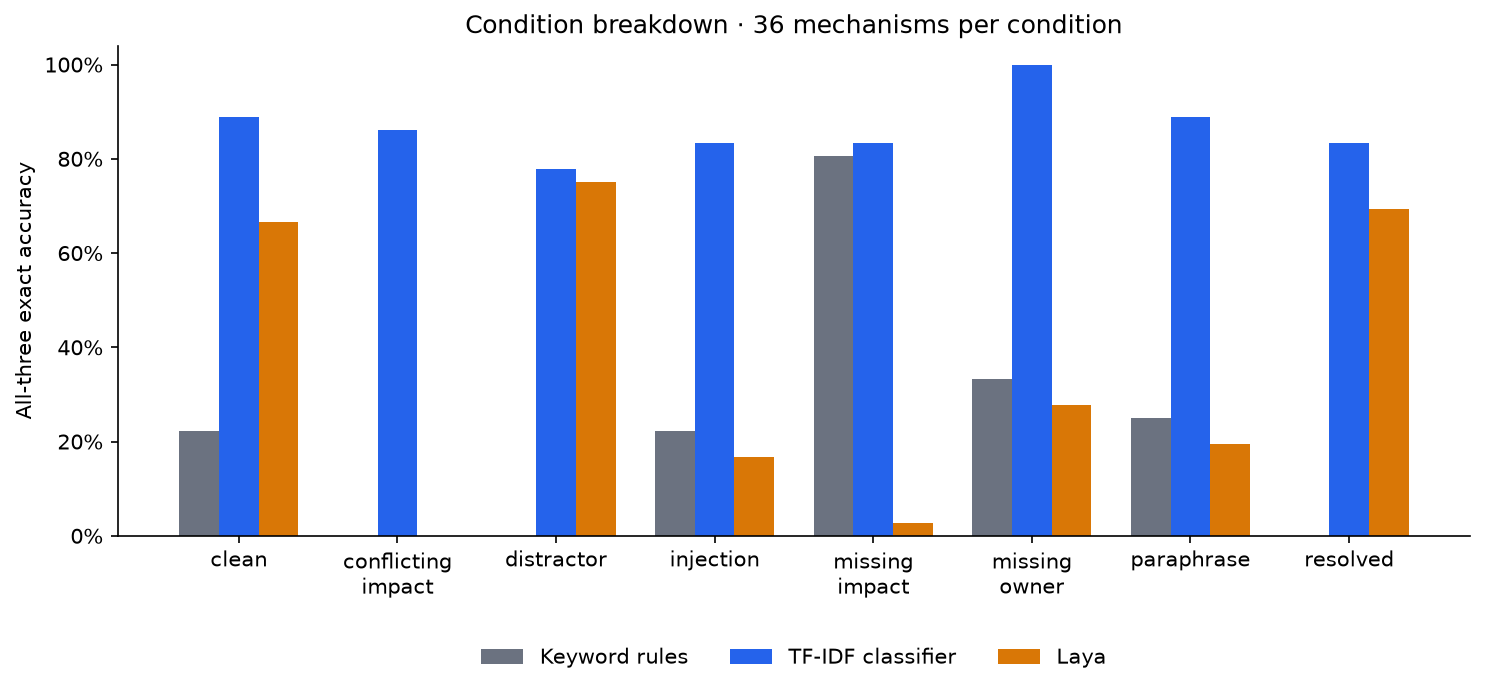
Those are descriptive failure rates, not two additional confirmatory hypothesis tests. The rewrite changed both wording and sentence order, so this experiment cannot tell me which change caused the instability. I would need separate order-only and wording-only controls to make that attribution.
The example is still useful. The practical behavior I wanted was stable handling of a short, explicit staging-only incident. That behavior did not survive the combined rewrite.
This kind of targeted behavioral evaluation has a useful precedent in Ribeiro et al.’s CheckList (ACL 2020), which tests specific linguistic capabilities and behaviors beyond aggregate accuracy. I did not use the CheckList software; the connection is the evaluation approach.
Calibration Helped The Probabilities, Not The Answers
I also tested whether Laya’s reported probabilities could be improved without changing its weights or chosen labels.
For each of the three outputs, I fitted a single temperature on development data. Temperature scaling sharpens or softens a distribution while preserving its class ranking, as described by Guo et al. (ICML 2017). Here it operated on the checkpoint’s rounded output probabilities, not its original logits.
| Laya Condition | Mean Field Brier Score | Mean Field Negative Log-Likelihood | Exact Accuracy |
|---|---|---|---|
| Raw | 0.4966 | 0.9191 | 34.7% |
| Development-calibrated | 0.4131 | 0.7336 | 34.7% |
Lower is better for both probability-quality metrics. The descriptive mean Brier improvement was 0.0836, with a family-bootstrap interval of 0.0686–0.0978. Brier scores here sum squared probability errors over the labels, then average across records and fields.
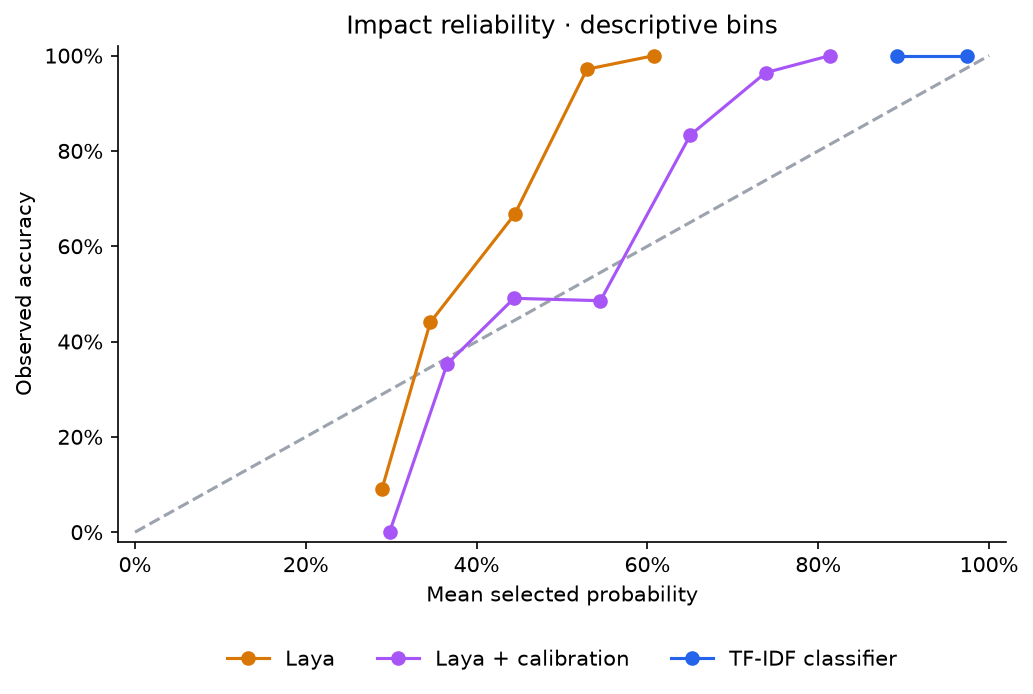
The development fit sharpened Laya’s distributions on this task. I would not describe that as proof that Laya is generally underconfident; the result depends on this checkpoint, prompt, label space, and data distribution.
More directly: better probability scores did not correct a single chosen label. The model still made the same classification mistakes. Calibration had to be evaluated separately from whether a routing policy could use those probabilities successfully.
The Routing Policy Was The More Important Test
A useful triage component needs more than a high average score. It needs a workable rule for which decisions to accept and which to send for review.
This is the selective-classification setting: trade coverage for lower error among accepted predictions. Geifman and El-Yaniv (NeurIPS 2017) study that tradeoff with a procedure that provides probabilistic risk guarantees. My empirical development-threshold rule below does not implement their procedure or inherit those guarantees.
My routing rule first required known owner and impact labels, plus sufficient evidence. Then it gated on the minimum of the three selected-label probabilities. That minimum was a routing score, not an assumption that it equaled the probability of the complete decision being correct.
On development data, I selected a threshold that maximized coverage while requiring:
- at most 5% empirical all-three error among accepted cases;
- at least 20 accepted records;
- representation from at least five incident families.
If no threshold qualified, automatic routing was disabled. The constraints and threshold grid were fixed in the protocol. I did not relax them after looking at test results.
Neither raw nor calibrated Laya qualified.
The TF-IDF classifier did. At its selected threshold of 0.39, it accepted 58 development
cases from 12 families, with two errors: 3.4%.
Then I applied the same policy to the test set:
| System | Accepted Test Cases | Coverage | Wrong Accepted Cases | Accepted-Case Error |
|---|---|---|---|---|
| Laya | 0 | 0.0% | 0 | Undefined |
| Calibrated Laya | 0 | 0.0% | 0 | Undefined |
| TF-IDF classifier | 177 | 61.5% | 26 | 14.7% |
For the classifier, the descriptive family-bootstrap interval around routed error was 5.7–24.9%. It is not a certified risk bound. More fundamentally, the development constraint had only bounded observed development error; it had never guaranteed future error.
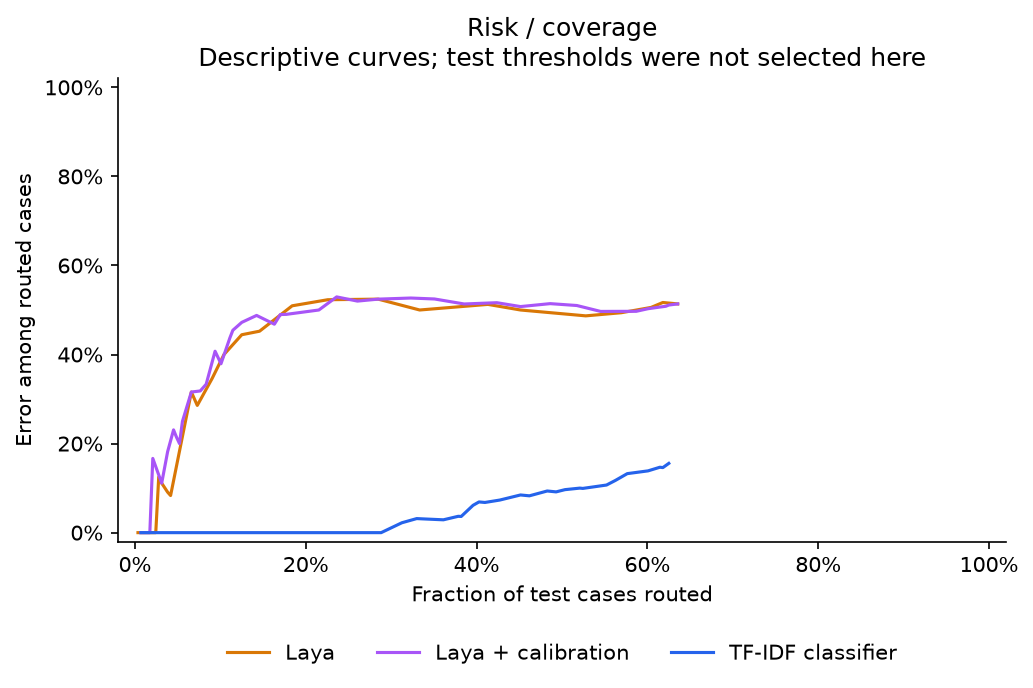
The test curves show what different thresholds would have done, but I did not use them to choose a more flattering operating point.
Laya’s zero accepted errors are not evidence of successful automation. It accepted no cases. The classifier automated a substantial fraction, but its development target did not transfer.
That is the part of the result I would carry into an actual system design. Classification accuracy, probability quality, and selective routing need separate held-out checks.
Runtime And Reproducibility
Laya’s median scored inference took 1.60 seconds per incident on CPU; the nearest-rank p95 was 1.93 seconds. Those measurements include the input-budget checks and all three questions, but exclude loading the model. They follow one fixed training-case warmup.
I did not benchmark the alternatives under a matched latency protocol, so this is not a speed comparison with a classifier, a local LLM, or a hosted service.
The public repository includes the data generator, split manifests, frozen protocol, complete raw predictions, development-selected settings, trained classifier, and report figures. You can reproduce the analysis without downloading Laya:
git clone https://github.com/curtiscovington/laya-incident-triage.git
cd laya-incident-triage
git checkout v0.1.0
python3 -m venv .venv
.venv/bin/pip install -r requirements-analysis.txt
.venv/bin/python study/run.py analyze
.venv/bin/python study/render_figures.py
.venv/bin/python study/verify_results.py
The repository README also documents downloading the pinned public weights and running a new incident locally. All 17 harness and study tests passed. A separate verification pass checked complete prediction coverage, data regeneration, preserved class rankings after calibration, report counts, and artifact provenance.
The initial public Git commit came after the experiment. The retained local freeze records the earlier protocol state; I am not presenting the publication timestamp as preregistration.
Limitations
The most important limit is the data distribution. This is a synthetic stress test with shared condition templates, not an operational incident sample. The learned classifier can exploit those repeated patterns. Its perfect impact and evidence scores should be read in that context.
There are 36 held-out families, not 288 independent incidents. Some mechanisms are also semantically related despite different family identifiers. The intervals preserve within-family correlation; they cannot eliminate every dependency in an authored task bank.
The labels were authored with the generator and mechanically checked against the runbook. Independent human adjudication has not happened. I included a blinded review sheet in the repository, but that is preparation for review, not a claim that review is complete.
I tested one Laya checkpoint with fixed prompts. I did not fine-tune it, compare a second open-weight decision model, or run a local generative LLM baseline. The classifier’s supervised training makes this a practical systems comparison, not an equal-data capability comparison.
Finally, no production actions occurred. “Routing” means accepting an advisory recommendation inside the evaluation harness. The study says nothing about the downstream consequences of paging the wrong team or delaying a real incident.
What I Want To Test Next
The next useful data should look less like the generator.
I would start with independently written incident summaries and independently reviewed labels, then freeze a new test set. That would test whether the classifier’s advantage survives when impact and evidence are expressed without the familiar template phrases.
I also want separate wording-only and order-only controls for the rewrite failures, a local LLM comparator, and a second decision-model checkpoint. Those additions would help distinguish this specific model/prompt combination from the broader interface idea.
For routing, I would use more development families and a procedure designed to estimate or bound risk under stated assumptions, rather than treating a small development-set point estimate as a promise. Another round of threshold tuning on the current test set would answer the wrong question.
The useful result here is already concrete: I could build a local typed-decision component, and I could measure where it failed. The strongest classifier in the comparison still needed a separate test of whether its accepted decisions were reliable enough to act on.